

A loud argument spills into a parking lot. A neighbor complaint turns into an arrest. A bar confrontation ends with handcuffs and a charge you did not see coming.
California Penal Code 415 covers all of these situations. It is the state’s disturbing the peace law, and it is also what officers mean when they call in a “415” over the radio.
The charge sounds minor. But a misdemeanor conviction under PC 415 means up to 90 days in jail, a fine, and a criminal record. Even an infraction stays on your record unless you take steps to clear it. This guide explains what PC 415 covers, how serious it actually is, and what you can do if you are facing a charge.
What Is PC 415? California’s Disturbing the Peace Law Explained
California Penal Code 415 reads:
“Any of the following persons shall be punished by imprisonment in the county jail for a period of not more than 90 days, a fine of not more than four hundred dollars ($400), or both:
(1) Any person who unlawfully fights in a public place or challenges another person in a public place to fight. (2) Any person who maliciously and willfully disturbs another person by loud and unreasonable noise. (3) Any person who uses offensive words in a public place which are inherently likely to provoke an immediate violent reaction.”
In plain English, PC 415 makes it a crime to fight in public, make unreasonable noise that disturbs others, or use words so inflammatory they are likely to cause immediate violence.
There are three separate ways to violate this law, and each one has its own set of elements. You can be charged under any one of them independently. Understanding which subsection applies to your situation matters because the defenses are different for each.
What Is the 415 Police Code?
When you hear officers radio a “415,” they are referring to a disturbing the peace call. California police radio codes are largely based on the corresponding penal code section numbers, so a 415 call directly refers to PC 415.
Common 415 dispatch variations you may hear or see on a police report include:
415 F – Fight in progress
415 M – Music or noise complaint
415 V – Verbal disturbance
415/2 – Loud noise complaint (referencing PC 415(2))
415/3 – Offensive language complaint (referencing PC 415(3))
415v – Verbal disturbance variant used in some jurisdictions
What the officer radioed in at the scene often reflects which subsection of PC 415 the charge is based on. If your arrest report shows a 415 F, the focus is on fighting. If it shows a 415/2, the focus is on noise. Knowing this helps you and your attorney understand exactly what the prosecution needs to prove.
What Is Breach of Peace?
Breach of peace is the broader common law concept that California’s PC 415 is rooted in. In California, the terms “breach of peace” and “disturbing the peace” are used interchangeably, but breach of peace is the older legal concept.
At its core, breach of peace means any act that disrupts public order or tranquility to the point where it could provoke a violent response, or causes actual disruption to others going about their lawful activities.
A few important points about how this concept works in practice:
No physical harm is required – You do not need to hurt anyone to breach the peace. Provocative words, unreasonable noise, or a public challenge to fight can all qualify.
No property damage is required – This is not vandalism or destruction. The focus is on disruption to public order.
The First Amendment sets real limits – Not all disruptive or offensive conduct qualifies. Courts have consistently held that constitutionally protected speech, political protest, and religious expression cannot form the basis of a disturbing the peace charge. The First Amendment is one of the most powerful defenses available under PC 415.
The Three Ways to Violate PC 415
PC 415(1)- Unlawful Fighting in a Public Place
To convict you under this subsection, a prosecutor must prove:
- You willfully and unlawfully fought another person, or challenged another person to a fight, and
- The fight or challenge happened in a public place
What “willfully” means – The act must be deliberate. Accidental physical contact, such as bumping into someone in a crowd, does not qualify.
What counts as a public place – Streets, sidewalks, bars, parking lots, parks, shopping centers, and other locations open to the public all qualify.
Challenging someone counts – You do not need to throw a punch. Walking up to someone and saying “let’s take this outside” in a threatening manner can be enough. California courts have also held that gang gestures can constitute challenging someone to a fight.
Self-defense is an explicit exception – If you fought back because you reasonably believed you were about to be harmed, and your force was proportionate to the threat, you may not be guilty under this subsection.
Real-world example: Two men get into an argument at a Bakersfield bar. One says “I’ll meet you in the parking lot” and walks toward the exit. That challenge alone, made in a public place, can be charged under PC 415(1) even if no fight ever happened.
PC 415(2)- Unreasonable Noise
To convict you under this subsection, a prosecutor must prove:
- You willfully and maliciously caused loud and unreasonable noise, and
- The noise actually disturbed another person
What “maliciously” means – You acted with intent to annoy or injure someone else. Careless noise, such as a loud party where you did not realize how far it carried, generally does not meet this standard. Intent is the dividing line.
Two ways the noise can qualify –
- It created a clear and present danger of immediate violence, or
- It was used to disrupt lawful activities rather than to communicate
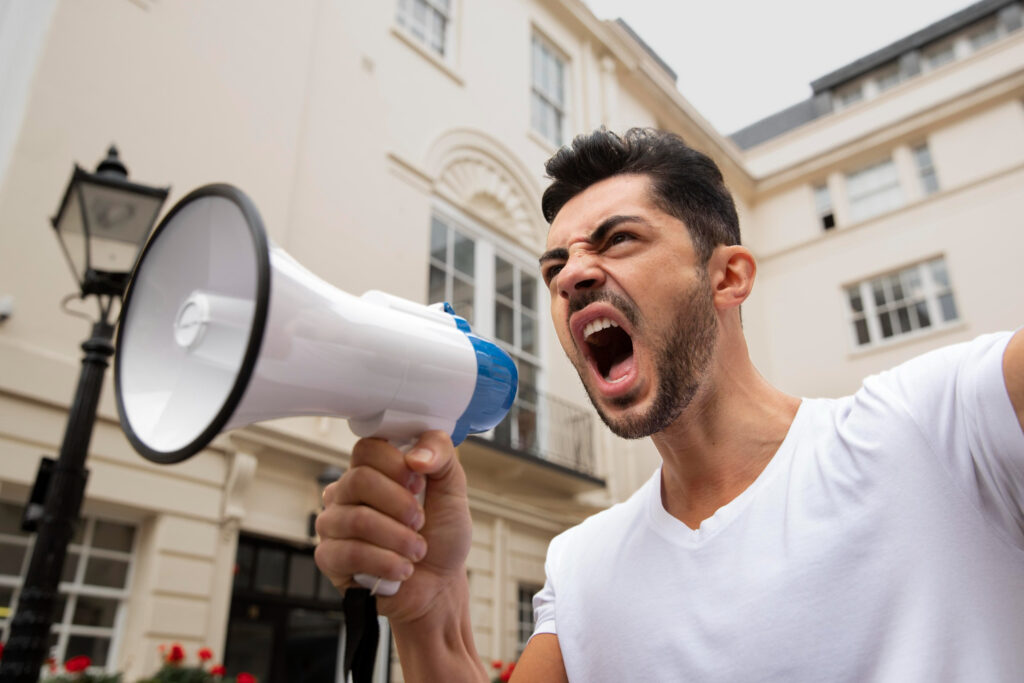
That second point matters for protests and rallies. A political group using a loudspeaker in a public park to address their members is communicating, not disrupting. That is generally protected. Someone blasting music at a neighbor’s home specifically to harass them after an argument is disrupting, not communicating. That can qualify.
Real-world example: After a dispute with a neighbor, a person parks outside their home and plays loud music at full volume for hours with the windows down. This is deliberate, malicious, and aimed at disturbing a specific person. That is PC 415(2).
PC 415(3)- Offensive Words / Fighting Words
To convict you under this subsection, a prosecutor must prove:
- You used offensive words in a public place, and
- Those words were inherently likely to provoke an immediate violent reaction
The fighting words doctrine – This subsection is rooted in the constitutional concept of “fighting words,” words so inflammatory that a reasonable person would immediately respond with violence. This is a high standard. General profanity, insults, and offensive opinions are typically not enough.
You do not need to intend to provoke violence – If a reasonable person in the other party’s position would have reacted with immediate violence, the standard may be met regardless of your intent.
First Amendment protection – This is the most important limit on PC 415(3). Courts have consistently held that words used during political protests, religious expression, or general public discourse are protected, even if offensive to others. The First Amendment provides a strong defense here.
Real-world example: A person approaches a stranger on the street and directs a targeted racial slur at them during a heated confrontation. The other person immediately becomes aggressive. The first person can be charged under PC 415(3) regardless of whether they intended to start a fight.
Does California Have Mutual Combat?
Mutual combat refers to a situation where two people voluntarily agree to fight each other. Many people assume that if both sides wanted the fight, no one can be charged.
That assumption is wrong in California.
Mutual combat does not make fighting legal under PC 415. Both participants can be charged even when both agreed to the fight. The law is focused on public order, not individual consent. What two people agree to between themselves does not override the state’s interest in keeping public spaces free from violence.
This matters practically. If you and another person square up outside a bar by mutual agreement, you can both be arrested and charged under PC 415(1). Saying “he wanted to fight too” is not a defense.
Where it gets complicated: if you agreed to fight but the other person escalated far beyond what was reasonably agreed upon, such as pulling out a weapon, the self-defense argument becomes available and the mutual combat framework breaks down.
Is PC 415 a Felony or a Misdemeanor?
PC 415 is a wobblette. That means a prosecutor has the discretion to charge it as either a non-criminal infraction or a misdemeanor depending on the circumstances of the case and your prior criminal history.
As an infraction –
- Fine up to $250
- No jail time
- Non-criminal offense
- Does not create a criminal record in the traditional sense
As a misdemeanor –
- Up to 90 days in county jail
- Fine up to $400
- Criminal record
- May affect employment, professional licensing, and housing applications
What determines which way it is charged: first-time offenders with no aggravating factors are often charged with an infraction. Cases involving actual violence, repeated offenses, or situations where the conduct was particularly serious are more likely to be charged as misdemeanors.
This distinction matters enormously. An infraction and a misdemeanor are not the same thing legally or practically.
Penalties for PC 415 in Detail
Misdemeanor penalties –
- Up to 90 days in county jail
- Fine up to $400
- Summary probation
- A criminal record that shows up on background checks
Infraction penalties –
- Fine up to $250
- No jail time
- No criminal record
PC 415.5 — Disturbing the Peace on School Grounds
California has a separate statute for disturbances that occur on school, college, or university campuses. PC 415.5 is always charged as a misdemeanor, not an infraction.
First offense – Up to 90 days in jail and/or fine up to $400
Second offense – 10 days to 6 months in jail and/or fine up to $1,000
Third or subsequent offense – 90 days to 6 months in jail and/or fine up to $1,000
PC 415.5 does not apply to registered students at the school or to employees engaged in lawful activities. The statute is aimed at outsiders who come onto campus grounds to cause a disturbance.
Defenses to a PC 415 Charge
- No criminal intent – You did not act willfully or maliciously. If the noise was accidental, if the words were spoken without any intent to provoke, or if the physical contact was unintentional, the required mental state is missing. This is one of the most commonly used and effective defenses.
- Self-defense – You fought back because you reasonably believed you were about to be harmed, and the force you used was proportionate and necessary. This is an explicit exception built into PC 415(1). Video footage and eyewitness accounts are the most useful evidence for this defense.
- First Amendment protection – Your words or conduct were constitutionally protected. This applies most often to protests, political speech, religious expression, and public demonstrations. Even offensive speech is generally protected unless it crosses into true fighting words territory.
- False accusation – The complaint was fabricated. This is particularly common in neighbor disputes, where one party files a noise complaint as retaliation for something unrelated. Text messages, voicemails, and records of prior complaints can reveal the accuser’s motive.
- No actual disturbance occurred – For PC 415(2), the prosecution must prove that another person was actually disturbed. If nobody was disturbed, or if the disturbance cannot be established, the charge may not hold.
- Words were not fighting words – For PC 415(3), general profanity or offensive opinions do not qualify. The words must have been inherently likely to provoke immediate violence in a reasonable person. If the words, however objectionable, fell short of that standard, the charge should not stand.
Immigration, Expungement, and Gun Rights
Immigration
A PC 415 conviction does not trigger immigration consequences. Disturbing the peace is not classified as a crime involving moral turpitude. This is one of the reasons PC 415 is frequently offered as a plea bargain reduction for non-citizens facing more serious charges — it resolves the case without creating immigration risk.
Expungement
A PC 415 misdemeanor conviction can be expunged under California Penal Code 1203.4 after successfully completing probation or serving your jail sentence. Even if you violated a probation term, a judge has the discretion to grant expungement if you have otherwise demonstrated rehabilitation.
After expungement, the conviction is dismissed and does not appear on most private employer background checks. You can legally state you were not convicted in most non-government employment situations.
Gun Rights
A PC 415 conviction does not affect your right to own or possess firearms. It is not a felony, it is not a domestic violence related offense, and it is not a drug offense. None of the federal or California state triggers for firearm rights loss apply to a standard PC 415 conviction.
PC 415 as a Plea Bargain Reduction
One of the most important things to understand about PC 415 is its role in plea bargaining. Prosecutors regularly offer to reduce more serious misdemeanor charges down to a PC 415 infraction or misdemeanor as part of a negotiated resolution.
Why prosecutors offer it: it closes the case, avoids trial, and still results in some form of accountability. Why defendants often accept it: the consequences are dramatically lower than the original charge.
Common charges reduced to PC 415 include –
- Domestic violence battery (PC 273.5)
- Criminal threats (PC 422)
- Assault (PC 240)
- Battery (PC 242)
- Lewd conduct in public (PC 647a)
- Prostitution (PC 647b)
- In some circumstances, DUI
If your original charge is a domestic violence offense, for example, a reduction to PC 415 can mean the difference between a conviction that costs you your gun rights, triggers immigration consequences, and appears on professional license applications versus a minor infraction with none of those lasting effects.
This is one of the most practical reasons to have an attorney involved early. Knowing which charges are commonly reduced to PC 415 and pushing for that outcome from the start can change the entire trajectory of a case.
Related California Penal Codes You Should Know
- PC 240 (Assault) – An unlawful attempt to commit a violent injury on someone else, combined with the present ability to do so. More serious than PC 415 fighting.
- PC 242 (Battery) – Actual unlawful physical contact. Where PC 415 covers fighting in public broadly, PC 242 focuses on the physical contact itself.
- PC 422 (Criminal Threats) – Threatening to commit a crime that would result in serious bodily injury or death. A felony-level charge significantly more serious than PC 415(3).
- PC 403 (Disturbing a Public Meeting) – Disrupting or breaking up a lawful public assembly or meeting.
- PC 302 (Disturbing a Religious Meeting)- Disrupting a religious service with profanity, misbehavior, or unreasonable noise.
- PC 372 / 373(a) (Public Nuisance) – Sustaining a condition that interferes with the community’s use or enjoyment of public spaces.
- PC 148 (Resisting Arrest) – Obstructing or delaying a peace officer in the performance of their duties. Often charged alongside PC 415 when the arrest did not go smoothly.
- PC 602 (Trespass) – Entering or remaining on property without permission. Often accompanies noise and disturbance incidents.
What to Do If You Are Charged With PC 415
- Do not argue your case at the scene – The street or the parking lot is not the place to make your defense. Officers are gathering information, not evaluating your version of events. Anything you say can be used against you.
- Do not make additional statements – Beyond identifying yourself if legally required, you have the right to remain silent. Use it.
- Document everything as soon as possible – Write down or record on your phone exactly what happened: where you were, what was said, what you did, who else was present, and whether any cameras were nearby. Memory fades fast.
- Gather evidence – If there is surveillance footage from a nearby business, get it before it is overwritten. Collect witness contact information. Screenshot any relevant text messages or social media posts.
- Understand what you are actually facing – There is a significant difference between an infraction and a misdemeanor. Find out which one was filed before you make any decisions about how to respond.
- Contact a criminal defense attorney – Even for a charge that sounds minor, early legal advice can change the outcome. An attorney can often get a misdemeanor reduced to an infraction, or get the charge dismissed entirely, particularly for first-time offenders.
Frequently Asked Questions
What does 415 mean in police code?
When officers radio a “415,” they are calling a disturbing the peace incident. The code comes directly from California Penal Code Section 415. Variations like 415 F (fight), 415 M (music/noise), and 415 V (verbal disturbance) indicate which type of disturbance is involved.
Is PC 415 a felony or misdemeanor?
PC 415 is a wobblette. It can be charged as a non-criminal infraction (fine only, no jail, no criminal record) or a misdemeanor (up to 90 days in jail, fine up to $400, criminal record). The facts of the case and your prior history determine which is charged.
What are the three ways to violate PC 415?
PC 415 can be violated by unlawfully fighting or challenging someone to fight in a public place (415(1)), maliciously causing loud and unreasonable noise that disturbs another person (415(2)), or using offensive words in a public place that are inherently likely to provoke immediate violence (415(3)).
Does a PC 415 conviction affect immigration status?
No. Disturbing the peace is not classified as a crime involving moral turpitude. A PC 415 conviction does not trigger immigration consequences, which is one reason it is frequently used as a plea bargain reduction for non-citizens.
Can a PC 415 charge be expunged?
Yes. A PC 415 misdemeanor conviction can be expunged under California Penal Code 1203.4 after completing probation or serving your sentence. After expungement, the conviction does not appear on most private employer background checks.
Does PC 415 affect gun rights?
No. A PC 415 conviction does not affect your right to own or possess firearms. It is not a felony and does not fall under the domestic violence or drug offense categories that trigger firearm restrictions.
Why would a charge be reduced to PC 415?
PC 415 is commonly offered as a plea bargain reduction from more serious charges like domestic violence, criminal threats, assault, or battery. It carries significantly lower penalties, no immigration consequences, no effect on gun rights, and is expungeable. It is one of the most favorable outcomes available for defendants facing misdemeanor charges in California.
Contact a Bakersfield Criminal Defense Attorney
A PC 415 charge may seem straightforward, but the difference between an infraction and a misdemeanor is real, and the difference between a conviction and a dismissal matters more than most people realize until it shows up on a background check.
In Bakersfield and Kern County, how a 415 charge is filed and resolved often comes down to early intervention. An attorney who knows the local courts and prosecutors can often negotiate an infraction instead of a misdemeanor, push for a dismissal on a first offense, or use PC 415 as a favorable resolution if you are facing something more serious.
Contact our office for a free case review. We will look at the details of your situation and tell you honestly what your options are.